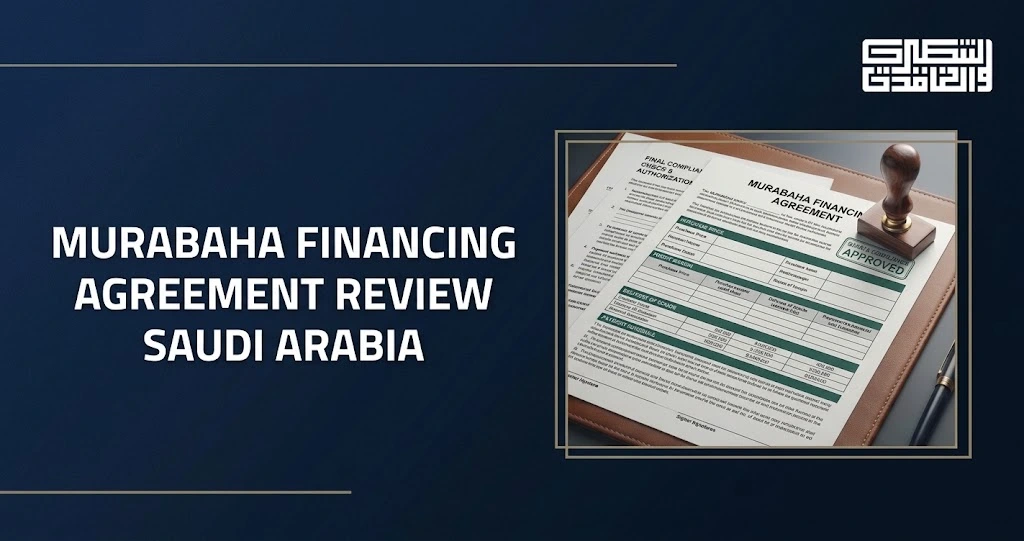
Murabaha Financing Agreement Review Saudi Arabia is not limited to checking the installment amount. It means confirming that the agreement matches what you were promised, including the financing structure, total price, fees, and your rights regarding early repayment. In brief, request the agreement summary and repayment schedule, compare them with the permitted fees and your rights under the Saudi Central Bank’s consumer finance rules, and do not sign an incomplete form. This guide explains the difference between Murabaha, Tawarruq, and lease-to-own financing, the seven clauses you should review, the updated administrative fee limits, and what to do if a contractual provision conflicts with your rights.
Murabaha is a sale contract in which the price of the asset and an agreed profit margin are disclosed. When reviewing the agreement, examine seven main areas: the financing structure and parties, price and annual percentage rate, repayment schedule, administrative fees, early repayment, late-payment and security provisions, and the agreement’s attachments. Under the Saudi Central Bank’s updated rules, the maximum administrative fee for non-real-estate financing is 0.5% of the financing amount or SAR 2,500, whichever is lower, following the December 2025 update. The rules also confirm the beneficiary’s right to early repayment.
What Is a Murabaha Financing Agreement Review in Saudi Arabia?
A Murabaha financing agreement review is the legal and financial examination of the agreement and its attachments before or after signing to verify the financing structure, cost, rights, and obligations.
Murabaha is a sale arrangement in which the sale price includes an agreed profit margin. It has developed into a commonly used form of Islamic financing. In consumer finance agreements for individuals, financing providers identify the financing structure, such as Murabaha or Tawarruq, in the standard-form agreement issued by the Saudi Central Bank, as explained in the FAQs on the Standard Form Consumer Finance Agreement for Individuals.
What Is the Difference Between Murabaha, Tawarruq, and Lease-to-Own Financing?
Murabaha involves a deferred sale price that includes a disclosed profit margin. Tawarruq involves purchasing a commodity on deferred payment terms and then selling it to obtain cash. Lease-to-own financing involves leasing an asset with ownership transferring to the lessee at the end, subject to the contractual terms.
The following table is a simplified practical comparison rather than a statutory classification.
| Financing Structure | How It Works | What to Review |
|---|---|---|
| Murabaha | The financier purchases the asset and sells it to you at a deferred price that includes the agreed profit. | Description of the asset, total price, and repayment schedule. |
| Tawarruq | You purchase a commodity at a deferred price and then sell it to obtain cash. | Commodity purchase and sale fees and who is responsible for the sale. |
| Lease-to-Own Financing | An asset is leased through installment payments and ownership transfers at the end under the agreement. | Timing of ownership transfer, maintenance, insurance, and what happens in the event of default. |
Source: Murabaha definition – Al Jazeera Encyclopedia. The descriptions of the other structures are practical explanations. Contract terms differ between financing providers, so the agreement itself should always be reviewed.
Do Saudi Central Bank Consumer Finance Rules Apply to Your Agreement?
The consumer finance rules apply to financing provided to individuals. Corporate and business financing is generally governed primarily by the relevant financing agreement, subject to the applicable regulations.
The updated consumer finance rules establish minimum information that must be included in the agreement, require the financing provider to provide a clear financing agreement summary, regulate the calculation of the Annual Percentage Rate (APR), and confirm the beneficiary’s right to early repayment.
The APR is intended to reflect the effective cost of financing and includes applicable costs and administrative fees for comparison purposes.
7 Clauses to Check in a Murabaha Financing Agreement Review Saudi Arabia
A proper review should cover seven main areas: the financing structure, price, installments, fees, early repayment, default provisions, and attachments.
- Financing structure and parties: Check the financier’s name, your name, the financing structure Murabaha, Tawarruq, or lease-to-own and the description of the asset or commodity.
- Price and Annual Percentage Rate: Review the financing amount, total amount payable, and APR showing the effective cost of the financing.
- Repayment schedule: Check the number of installments, payment dates, and installment amounts, and confirm that they match the financing agreement summary.
- Fees: Review administrative, procedural, recurring, and non-recurring fees and confirm that applicable fees remain within the permitted limits.
- Early repayment: Check how the full early settlement amount is calculated and whether any permitted compensation or charges apply.
- Late payment, default, and security: Review late-payment provisions, events of default that may accelerate outstanding obligations, guarantors, and any required security.
- Attachments and signatures: Confirm that all pages and attachments are complete and that no blank fields remain before signing.
The Saudi Central Bank rules state that a financing agreement should disclose recurring and non-recurring fees, including administrative and procedural expenses and late-payment charges, as well as the procedures and provisions governing early repayment, as explained in the Saudi Central Bank Consumer Finance Rules.
The Saudi Central Bank and the Saudi Banks Federation have also advised customers not to sign blank or incomplete forms.
Do you have a financing agreement and are concerned that it may contain fees or obligations that do not appear clearly in the agreement summary? The team at Al-Shatiri & Al-Ghamdi Law Firm can help you understand the available options, review the provisions of your agreement, and identify the documents you should examine before signing.
Contact a Specialized Legal Partner
Would you prefer to understand the details first? Continue reading this guide to review the relevant rules and procedures before contacting us.
What Administrative Fees Are Permitted Under a Financing Agreement?
Following the December 2025 update, the maximum administrative fee for non-real-estate financing products became 0.5% of the financing amount or SAR 2,500, whichever is lower. The previous limit was 1% of the financing amount or SAR 5,000, whichever was lower.
The update was introduced through the Financial Institutions Services Tariff Guide announced by the Saudi Central Bank and was stated to become effective 60 days after publication, according to an Okaz report on the Saudi Central Bank announcement.
This information was updated through October 2026 based on reports covering the Saudi Central Bank announcement. Fees may change, so review the current tariff guide issued by the Saudi Central Bank before signing. Some older FAQ pages may still display the previous limits.
| Item | Previous Limit | After the Update |
|---|---|---|
| Administrative fees for non-real-estate financing products | 1% or SAR 5,000, whichever is lower | 0.5% or SAR 2,500, whichever is lower |
For Tawarruq financing, administrative fees include commodity purchase and sale fees but do not include government taxes. The financing provider should disclose these charges clearly.
Can You Cancel a Murabaha Agreement After Signing?
Do not assume that a general cancellation period automatically applies. The Saudi Central Bank’s consumer finance rules provide a 10-business-day cancellation period while excluding transactions based on the principle of avoiding interest.
The relevant rule provides that, except for such transactions, a borrower may cancel acceptance of a consumer financing agreement within a period not exceeding 10 business days without providing reasons.
Because Murabaha is an Islamic financing structure, ask the financing provider in writing whether a cancellation right applies to your specific agreement before signing. Do not rely on a cancellation period that is not supported by the applicable rules or agreement.
How Does Early Repayment Work Under a Murabaha Financing Agreement?
The beneficiary may request early repayment, in full or in part, at any time, subject to the applicable rules. The beneficiary should not bear the financing cost attributable to the remaining period of the agreement.
The Saudi Central Bank has confirmed the beneficiary’s right to accelerate repayment of the outstanding financing amount without bearing the remaining term cost, subject to the maximum compensation that the financing provider may be entitled to receive.
The standard-form agreement regulates the calculation of full early repayment. Partial early repayment is handled under the financing provider’s procedures, provided those procedures do not conflict with the beneficiary’s rights.
If a full early settlement amount is paid but an installment is deducted before the payment is processed, the financing provider should accept the settlement amount and reverse the deducted installment in accordance with the applicable rules.
The beneficiary is also entitled, upon request, to a detailed account statement without charge, allowing the beneficiary to verify the fees and financing profits claimed.
What Should You Do If You Find a Problematic Clause or Fall Behind on Payments?
First document your concern in writing to the financing provider and retain copies of the agreement and all correspondence. Consider obtaining legal advice before escalating the matter.
The following are practical steps:
- Compare the agreement with the agreement summary and repayment schedule and identify the exact inconsistency.
- Contact the financing provider in writing, identify the disputed provision, and request clarification or correction.
- If the issue is not resolved, escalate the complaint through the official complaint channels of the authority regulating the financing provider.
- Do not stop making installments before understanding the effect on maturity, default provisions, and any applicable charges.
- Consult a lawyer where the default or dispute involves a significant amount or complex contractual issues.
You can review our legal consultation services or our documentation services for settlement agreements.
Common Mistakes When Signing a Financing Agreement
The following are recurring practical mistakes rather than official statistical findings:
- Signing an incomplete form or one containing blank fields.
- Looking only at the monthly installment without reviewing the total amount payable and the Annual Percentage Rate.
- Failing to compare the stated administrative fees with the applicable maximum limits.
- Confusing Murabaha, Tawarruq, and lease-to-own financing despite the differences between their structures.
- Failing to request a detailed account statement before making early repayment.
- Assuming that a cancellation period automatically applies after signing.
Frequently Asked Questions About Murabaha Financing Agreement Review Saudi Arabia
Is Murabaha an interest-bearing loan?
No. Murabaha is structured as a sale in which the price of the asset includes an agreed profit margin. The specific rights and obligations depend on the financing agreement itself.
Should I receive a summary of the financing agreement?
Yes. The updated rules require a clear summary of the financing agreement containing its key information.
What is the Annual Percentage Rate?
The Annual Percentage Rate, or APR, is a standardized measure used to disclose the effective cost of financing. It incorporates applicable costs and administrative fees and helps consumers compare financing products.
Should I sign an incomplete financing form?
No. Saudi Central Bank guidance advises customers not to sign blank or incomplete forms and to make sure that all agreement pages and fields are complete before signing.
Do administrative fees include commodity purchase and sale charges in Tawarruq?
Yes. Administrative fees in Tawarruq arrangements include commodity purchase and sale charges, while government taxes are excluded.
Can a financing provider refuse partial early repayment?
The beneficiary may request partial early repayment. The process is handled under the financing provider’s procedures, provided those procedures do not conflict with the beneficiary’s applicable rights.
Can I obtain a free account statement before early repayment?
Yes. Upon request, a borrower may obtain a detailed account statement without charge in connection with early repayment or non-performance of financing obligations, subject to the applicable rules.
Do these consumer finance rules apply to corporate financing?
The rules discussed in this article are directed at consumer financing for individuals. Corporate and business financing is generally governed by the financing agreement and any regulations applicable to the specific transaction. A company should review its agreement separately
Does lease-to-own financing transfer ownership automatically?
Ownership transfers in accordance with the terms stated in the agreement. Review the ownership transfer clause, insurance obligations, and maintenance provisions before signing.
Where should I file a complaint against a financing provider?
Begin with the financing provider’s internal complaint channels. If the issue is not resolved, the complaint may then be escalated through the appropriate regulatory complaint channel.
A Murabaha Financing Agreement Review Saudi Arabia should begin by comparing the agreement summary with the repayment schedule and then examining the fees, early repayment provisions, default clauses, and related obligations before signing.
Do not sign an incomplete agreement, do not assume that a cancellation period automatically applies, and request a detailed account statement when considering early repayment.
If a provision in your financing agreement is unclear or you are already in dispute with the financing provider, consider obtaining legal advice before taking further action. You can contact our team.
Sources
- Consumer Finance Rules – Saudi Central Bank.
- Updated Consumer Finance Rules – Saudi Central Bank.
- FAQs on the Standard Form Consumer Finance Agreement for Individuals – Saudi Central Bank Rulebook.
- Okaz report on the updated Financial Institutions Services Tariff Guide.
- Murabaha Contract – Al Jazeera Encyclopedia.